A small companion bulldog with erect "bat ears," the French Bulldog originated among English lacemakers, was refined in Paris, and is now the most registered breed in the United States.


Nottingham lacemakers kept small toy Bulldogs, and when the Industrial Revolution displaced their trade many emigrated to Normandy in the 1860s, taking the dogs with them.2 In France the type was crossed with local terriers and small breeds and became fashionable in Paris — with shopkeepers, then with artists and with the demi-monde of Montmartre.
American buyers took to the breed in the 1890s and, critically, insisted on the erect bat ear over the English rose ear; the French Bull Dog Club of America, formed in 1897, wrote the bat ear into the standard and fixed the breed's defining feature.1 The AKC recognised the breed in 1898. In 2022 the French Bulldog became the most registered AKC breed, ending the Labrador's thirty-one-year run.1
The name records the breed's refinement in France rather than its English origin — the dogs became known as bouledogue français in Paris and returned to the English-speaking world under that name. English breeders objected to the label for decades on the grounds that the foundation stock was theirs.2
| Life expectancy | 10–12 years |
|---|---|
| Height — male | 11–13 in (28–33 cm) |
| Height — female | 11–13 in (28–33 cm) |
| Weight — male | under 28 lb (13 kg) |
| Weight — female | under 28 lb (13 kg) |
| Coat type & colors | Short, smooth, fine; brindle, fawn, white, cream and combinations |
| Shedding | Low to moderate |
| Exercise needs | Low — short, cool-weather walks |
| Country of origin | France / United Kingdom |
| AKC group | Non-Sporting Group (AKC) |
| Prestige Breed size class | Medium Breed · 25 – 60 lbs |
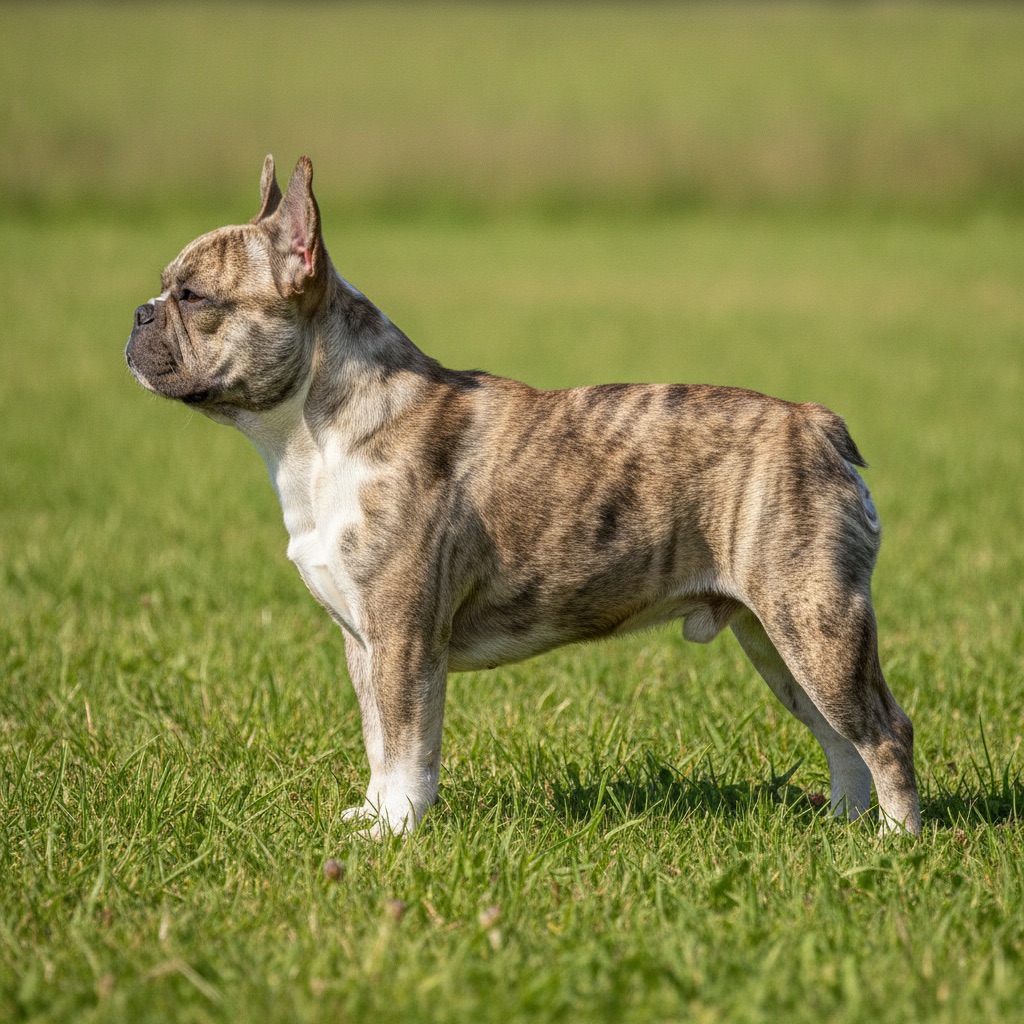
The AKC describes the French Bulldog as adaptable, playful and smart.1 The breed is a companion animal in the fullest sense: it wants human company more or less constantly and is generally poor at being left alone.
Frenchies are alert but not typically yappy, comic in temperament and adaptable to apartment living. They are stubborn in training and respond best to short, food-driven sessions. Their popularity has produced widespread irresponsible breeding, and buyers should be exacting about health testing and source.

A French Bulldog named Gamin de Pycombe was among the dogs aboard the Titanic; insured for £150, he was lost with the ship.2
Extreme demand has flooded the market with poorly bred dogs. Insist on airway, spine and patella evaluation of parents.3
Snorting, snoring and exercise intolerance indicate brachycephalic obstructive airway syndrome, which is treatable — not a normal breed trait.4
Frenchies overheat rapidly and most cannot swim; a front-heavy body and short muzzle make water genuinely dangerous.
Screw tails are associated with hemivertebrae. Report any hind-limb weakness or incoordination to a veterinarian promptly.3
This guide is educational and is not veterinary advice. Breed standards, measurements and health information are drawn from the sources listed above; consult your veterinarian for guidance specific to your dog.
Prestige Breed makes a medium breed multivitamin designed for breeds like the French Bulldog — see the French Bulldog Multivitamin.